
Read Between the Documents.
See the Bigger Picture. Go beyond individual files. Connect facts, uncover relationships, and understand the full context behind your business documents—with every answer grounded in evidence.
Most of what your company knows isn’t written down. It lives in the heads of the analyst who knows which clause matters, the underwriter who spots the red flag, the reviewer who remembers why a vendor got an exception. When they leave, that knowledge walks out with them, and the next person starts from zero.
a21.IDP captures it. Every document, every reviewer decision and every correction becomes part of a permanent, cited record of how your business actually works, one that stays when people move on.
Turn contracts, invoices, financial statements, and regulatory filings into a living, connected record of your business. a21.IDP turns your documents into a semantic layer that AI agents can reason over: an ontology, a knowledge graph and a cited wiki. It's neurosymbolic by design: the language model reads and proposes, and symbolic rules decide what becomes knowledge.
One engine. Any domain. Adapt the ontology to cover new document types without rebuilding the core platform. Every step retains an audit trail, keeping your knowledge traceable from source document to downstream workflow.
Scanned pages, handwriting, stamps, skewed photos, nested tables and 500-page files with mixed layouts go through one ingestion pipeline. Layout-aware OCR and vision models handle pages that text extraction breaks on. Every page is quality-scored, and low-confidence regions go to review instead of slipping through.
Every workspace starts from a domain ontology that defines the classes, properties and allowed relationships in your documents. Identity and normalization rules decide when two mentions are the same entity. Extend it with no code. Every change is versioned, and you can see its impact before you save it.
Ontology-guided entity recognition and relationship extraction pulls entities, relationships and attributes from every document, each with a confidence score and the exact sentence it came from. Validation and reasoning against the ontology decide what's kept, and entity resolution merges duplicates across documents. Every fact keeps its provenance.
A two-tier knowledge architecture pairs a lexical layer of indexed passages with a semantic layer of validated facts, and GraphRAG retrieval follows connections multi-hop across both to surface evidence that search alone would miss. Every connection is a recorded fact, so retrieval is deterministic and every answer is citation-backed
The knowledge graph is compiled into cited wiki pages for the key entities, documents and topics in your corpus. When a new document changes the facts behind a page, the page is rewritten automatically and the old version is kept, while conflicting values stay side by side for a person to decide.
Every workspace gets a domain-specialist agent, and every agent runs on the same agent harness with its own domain skills, domain tools and guardrails. It works across the knowledge graph, the wiki and your documents to extract, compare and analyse what matters in your domain, and computes every number instead of guessing.
Turn the questions your team keeps asking into reusable skills. The agent can propose new skills for a person to approve, and workspace memory keeps your team's conventions, so no conversation has to learn them again.
Every answer comes with its provenance and verified citations, plus charts, tables and timelines built from the same evidence. Human-in-the-loop review covers conflicts and approvals, sensitive data can be redacted, and every workspace is sealed off from the others
Every IDP workspace becomes a knowledge source for a21.Brain. The validated graph, cited wiki and approved skills built here are available to agents across the enterprise, so a sales agent, a compliance check or an engineering assistant works from the same verified facts. Build it once in IDP; use it everywhere through Brain or any of your AI Agent.
When an expert leaves, their judgement doesn’t. Approved procedures, corrections and review decisions are captured as reusable skills and workspace memory, so new team members start from what the company already knows.
Every answer traces back to its source document and exact sentence. Evidence is checked, and queries are logged for a clear audit trail.
Adapt the ontology to new document types without rebuilding the core engine. Preview the impact of changes and identify documents that need reprocessing.
Capture expert judgement as reusable skills. Approved procedures, corrections, and workspace knowledge carry forward as the system evolves.
Turn connected facts into readable, cited pages. When documents change, update affected pages while preserving version history.
Keep conflicting values visible for review instead of silently overwriting them. Preserve the evidence and decisions behind the record.
One engine. Any domain. Define what matters, connect your documents, validate the results, and deploy a domain expert that gets more useful with every review.
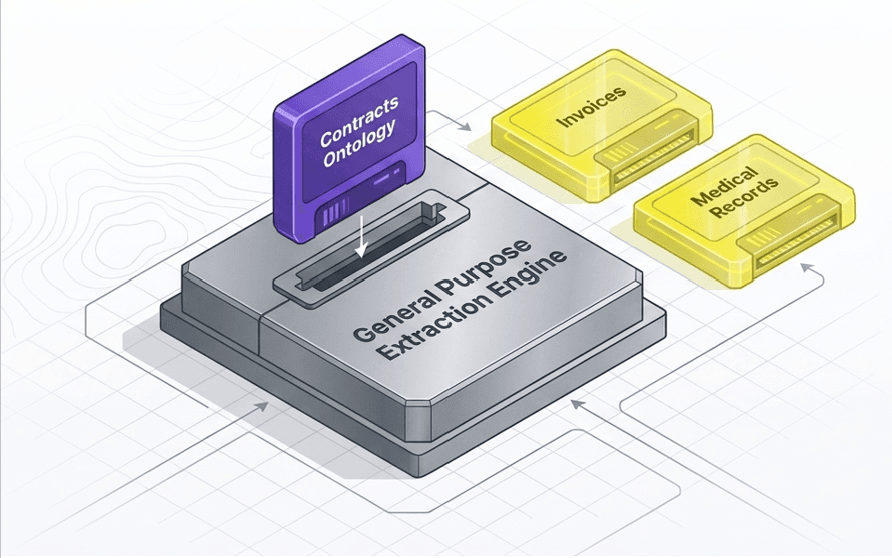
Choose your document types and customize a domain ontology to capture the classes, attributes, and relationships that matter to your business—from pricing and guarantees to obligations and deadlines.
Bring in documents at any volume and in any condition: scanned, handwritten, multilingual or hundreds of pages long. Layout-aware reading preserves tables and cross-page references. Facts are extracted, validated and linked in a knowledge graph, and entity resolution merges the same party across thousands of files. Your workspace’s domain agent then turns the graph into a living, cited wiki.
Test answers against historical cases before deployment. Conflicting values, uncertain matches, and high-risk actions go to human review with evidence attached. Approved decisions and reusable skills carry forward.
New documents update the knowledge graph and refresh affected wiki pages. PDF integrity checks, workspace-level permissions, and query logs support controlled, auditable workflows. Reviews and approved skills preserve what your team learns. Connect the workspace to a21.Brain, and the same verified knowledge powers agents across the enterprise
Follow the connections across the whole data room. Multi-hop GraphRAG links parties, ownership, transactions and obligations across thousands of documents, surfacing related-party exposure and hidden dependencies that keyword search misses.
Know what you’ve actually agreed to. Link master agreements, amendments and side letters into one graph, so every obligation reflects its latest version. Compare terms against your playbook and trace answers to the source clause.
Decide faster, with evidence. Read faxed requests, scanned clinical notes and lab reports, and match them against medical policy, formulary and step-therapy criteria. Reviewers get a criteria-by-criteria summary with each finding cited to the page it came from, while clinicians make the final determination.
Connect requirements to the rules. Extract filing data, link obligations to relevant regulations, and trace each requirement to its source.
Build one verified customer record. Consolidate identity data across documents, match records to the same person, and flag document integrity issues.
Review 500+-page claim files in minutes. Read scanned medical records, handwritten notes and policy documents together, surface conflicting information, and give reviewers an evidence-backed summary
Voice-enabled multi-agent SFE analytics eliminated SQL dependency for 50+ sales directors — reports in seconds, not days.
Read Case Study →"Nanodoc" underwriting automation processed 120+ PDF bank statements per application, cutting manual extraction time dramatically.
Read Case Study →Multi-agent LangGraph sales narrative generation compressed a multi-week analyst cycle into hours.
Read Case Study →GraphRAG-powered intelligence analysis reduced turnaround time for time-critical operations, deployed fully sovereign on-prem.
Read Case Study →Knowledge Graph + RAG for change management targeting a 40% cycle time reduction, built audit-ready for FDA/ISO.
Read Case Study →Real-time stress-scoring early warning system generated $10.5M in net new GMV.
Read Case Study →"AI Pandit" RAG chatbot targets 60-70% support deflection for a fast-growing devotional services platform.
Read Case Study →How a US SaaS Company Used Agentic AI to Decode PBM Reports for Brokers and Onboard 30+ Customers
Read Case Study →How a US Pharma Analytics Consultancy Turned Quarterly Territory Clean-Up into a Repeatable AI Workflow Across 3 Pharma Companies
Read Case Study →